I am in South Africa and may well be posting thoughts about it to Twitter.
As you were.

Month: October 2009
So, I was invited to take part in a debate at the Cambridge Union on Thursday night. We were debating the motion “This House Believes That Political Correctness is Sane and Necessary”, and naturally, I was proposing the motion.
On my side of the floor was New Statesman political editor Medhi Hasan and Times Columnist David Aaronovich. Facing us were UKIP candidate Will Burrows, Ann Widdecombe MP, and Alex Deane.
Since Political Correctness deals with how people express themselves, why they say and write, I thought it was important to have a go at reconciling it with Free Speech. What sort of political correctness could a campaigner with English PEN endorse?
Below is an approximation of my speech. I did ad lib some hilarious, off the cuff remarks during the delivery, but these were not part of my notes. So please rest assured that although the following might seem earnest and dry, when I gave the speech all the students were rolling in the aisles…1
Since the debate us now over, I will let this stand alone, but I’ll add another post later with more thoughts on the evening, and log some points (positive and negative) from the floor.
1. This may not be true.
Continue reading

Houses of Parliament at dusk. Photo by yrstruly on Flicker (CC licence)
This cannot be left without comment:
Today’s published Commons order papers contain a question to be answered by a minister later this week. The Guardian is prevented from identifying the MP who has asked the question, what the question is, which minister might answer it, or where the question is to be found.
The Guardian is also forbidden from telling its readers why the paper is prevented – for the first time in memory – from reporting parliament. Legal obstacles, which cannot be identified, involve proceedings, which cannot be mentioned, on behalf of a client who must remain secret.
If it is any consolation, the order papers are in the public domain1, so those with a mind to do so have followed the trail. The consensus on Twitter and the blogs is that it refers to this question:
Paul Farrelly (Newcastle-under-Lyme): To ask the Secretary of State for Justice, what assessment he has made of the effectiveness of legislation to protect (a) whistleblowers and (b) press freedom following the injunctions obtained in the High Court by (i) Barclays and Freshfields solicitors on 19 March 2009 on the publication of internal Barclays reports documenting alleged tax avoidance schemes and (ii) Trafigura and Carter-Ruck solicitors on 11 September 2009 on the publication of the Minton report on the alleged dumping of toxic waste in the Ivory Coast, commissioned by Trafigura.
Thanks to The Third Estate for doing the legwork.
It would be no surprise if these extrapolations turn out to be true. The Guardian has been following the Trafigura story for months and reported in May on the dumping of toxic ‘slops’ in the Ivory Coast. The theory is that the paper wanted to publish details of the Minton Report by consulting scientists MTD. The report recently appeared on Wikileaks.
This is also another example of the Streisand effect in action. The fascinating TrendsMap shows that the words ‘Trafigura’, ‘Dumping’, ‘Gagging’ and ‘Guardian’ are the most talked about keywords. As @alexmassie says on Twitter:
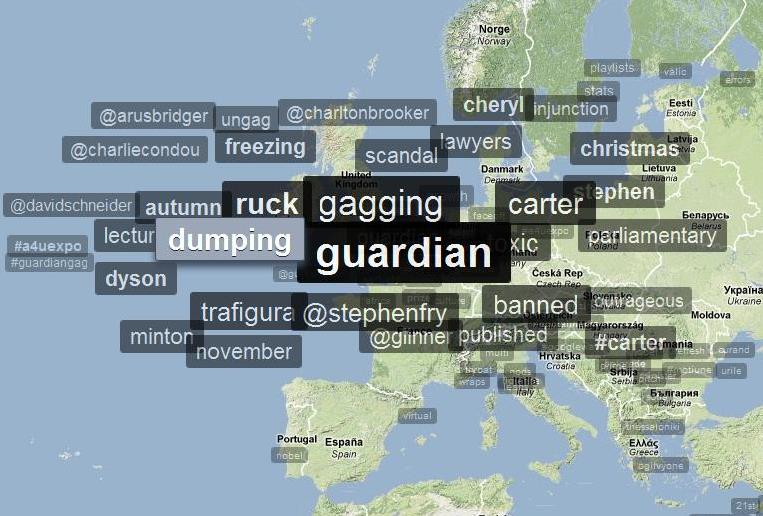
Had never heard of Trafigura until they tried to ban the reporting of parliamentary proceedings. Fools.
1. As an aside – The House of Commons website is bloody awful. Anyone using the official record for any reason is likely going to want to cite a particular column, line, or question, rather than an entire webpage. The list of questions should be properly numbered so I can link direct to the part I want – in this case, question 61.
A few things that I have been reading and listening to recently have got me thinking about sincerity. Here’s Hopi Sen, talking about the Labour Party Conference, and channelling David Foster Wallace in the process:
The next real literary “rebels” in this country [USA] might well emerge as some weird bunch of anti-rebels, born oglers who dare somehow to back away from ironic watching, who have the childish gall actually to endorse and instantiate single-entendre principles. …
These anti-rebels would be outdated, of course, before they even started. Dead on the page. Too sincere. Clearly repressed. Backward, quaint, naive, anachronistic. Maybe that’ll be the point. Maybe that’s why they’ll be the next real rebels. Real rebels, as far as I can see, risk disapproval. The old postmodern insurgents risked the gasp and squeal: shock, disgust, outrage, censorship, accusations of socialism, anarchism, nihilism. Today’s risks are different. The new rebels might be artists willing to risk the yawn, the rolled eyes, the cool smile, the nudged ribs, the parody of gifted ironists, the “Oh how banal.”Every time I read those closing lines, I think that he could just as easily be talking about modern politics, and that to succeed, to connect with people once more, politicians will have to tear away the protective masks they’ve placed on themselves … if the mask isn’t working any more, then the cause has to be worth risking the shame and embarrassment that will ensue when seen without it.
As I noted a couple of weeks ago, the triumph of hope over cynicism can be found in Foster Wallace’s Infinite Jest, too. Matthew Baldwin writes:
Infinite Jest provides is a 13 week irony detox program, designed to reduce the cynicism in your system at a slow enough rate that you don’t go all P.T.-Kraus-on-a-subway. …
As we reach the end of Infinite Jest the question becomes: can we retain the message that DFW struggled so mightily to impart, or is a relapse inevitable?
Hopi Sen goes on to suggest that David Cameron and Tony Blair are Martin Amis type politicians, and notes the emergence of Brett Easton Ellis types. When will we see the rise of the David Foster Wallace-type politico!? Could such a person exist? Who comes the closest in the modern era?
Meanwhile at the Free Word Centre, we’ve been treated to the talent of two poets-in-residence, Ray Antrobus (@theeducatedfool) and Joshua Idehen (@benincitizen). They’ve been writing poetry in the cafe and performing it at our desks. What was especially striking about their performances was the sincerity. We heard poems about despressing relationships with parents; expressions of love; and brutal break-ups with lovers (Ray’s “Hit Me” is particularly challenging).
I’m preparing a speech for a presentation I am doing in a couple of weeks, and the temptation, given the subject matter and audience, is to go in for point scoring. However, now I’m thinking I will try the sincere route instead. We shall see what happens.

Poet Joshua Idehen gives a farewell performance of his poem "My Love" at the Free Word Centre, Farringdon.

English PEN have produced a briefing document on the proposed new Criminal Memoirs law.
A new scheme will seize assets from ex-offenders who write about their crimes. All types of art and media will be affected, and there are few safeguards to prevent abuse.
English PEN is calling on the Government to withdraw the proposed new law from the Coroners & Justice Bill, and to consult with prisoner groups and rehabilitation charities.