Barrister

Author: Robert (Page 194 of 328)

Guardian Gagged

Houses of Parliament at dusk. Photo by yrstruly on Flicker (CC licence)

Houses of Parliament at dusk. Photo by yrstruly on Flicker (CC licence)


This cannot be left without comment:

Today’s published Commons order papers contain a question to be answered by a minister later this week. The Guardian is prevented from identifying the MP who has asked the question, what the question is, which minister might answer it, or where the question is to be found.
The Guardian is also forbidden from telling its readers why the paper is prevented – for the first time in memory – from reporting parliament. Legal obstacles, which cannot be identified, involve proceedings, which cannot be mentioned, on behalf of a client who must remain secret.

If it is any consolation, the order papers are in the public domain1, so those with a mind to do so have followed the trail.  The consensus on Twitter and the blogs is that it refers to this question:

Paul Farrelly (Newcastle-under-Lyme): To ask the Secretary of State for Justice, what assessment he has made of the effectiveness of legislation to protect (a) whistleblowers and (b) press freedom following the injunctions obtained in the High Court by (i) Barclays and Freshfields solicitors on 19 March 2009 on the publication of internal Barclays reports documenting alleged tax avoidance schemes and (ii) Trafigura and Carter-Ruck solicitors on 11 September 2009 on the publication of the Minton report on the alleged dumping of toxic waste in the Ivory Coast, commissioned by Trafigura.

Thanks to The Third Estate for doing the legwork.
It would be no surprise if these extrapolations turn out to be true.  The Guardian has been following the Trafigura story for months and reported in May on the dumping of toxic ‘slops’ in the Ivory Coast.  The theory is that the paper wanted to publish details of the Minton Report by consulting scientists MTD.   The report recently appeared on Wikileaks.
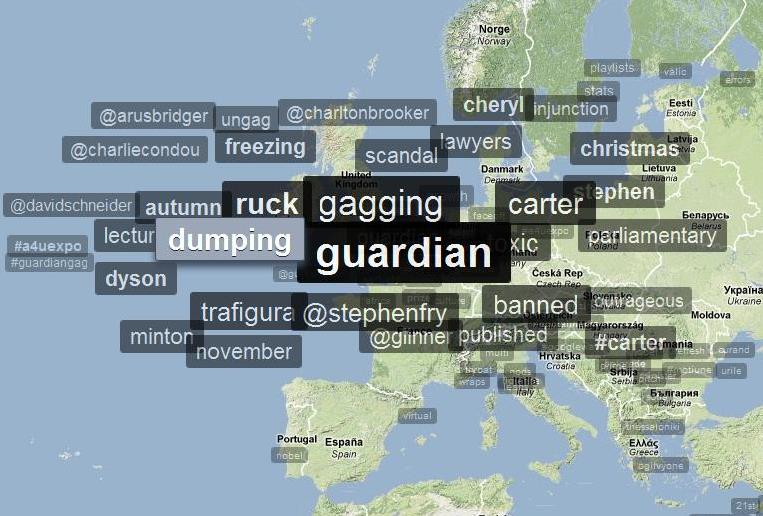
This is also another example of the Streisand effect in action.  The fascinating TrendsMap shows that the words ‘Trafigura’, ‘Dumping’, ‘Gagging’ and ‘Guardian’ are the most talked about keywords. As @alexmassie says on Twitter:

Had never heard of Trafigura until they tried to ban the reporting of parliamentary proceedings. Fools.


1. As an aside – The House of Commons website is bloody awful. Anyone using the official record for any reason is likely going to want to cite a particular column, line, or question, rather than an entire webpage. The list of questions should be properly numbered so I can link direct to the part I want – in this case, question 61.

The New Sincerity

A few things that I have been reading and listening to recently have got me thinking about sincerity.  Here’s Hopi Sen, talking about the Labour Party Conference, and channelling David Foster Wallace in the process:

The next real literary “rebels” in this country [USA] might well emerge as some weird bunch of anti-rebels, born oglers who dare somehow to back away from ironic watching, who have the childish gall actually to endorse and instantiate single-entendre principles. …
These anti-rebels would be outdated, of course, before they even started. Dead on the page. Too sincere. Clearly repressed. Backward, quaint, naive, anachronistic. Maybe that’ll be the point. Maybe that’s why they’ll be the next real rebels. Real rebels, as far as I can see, risk disapproval. The old postmodern insurgents risked the gasp and squeal: shock, disgust, outrage, censorship, accusations of socialism, anarchism, nihilism. Today’s risks are different. The new rebels might be artists willing to risk the yawn, the rolled eyes, the cool smile, the nudged ribs, the parody of gifted ironists, the “Oh how banal.”

Every time I read those closing lines, I think that he could just as easily be talking about modern politics, and that to succeed, to connect with people once more, politicians will have to tear away the protective masks they’ve placed on themselves … if the mask isn’t working any more, then the cause has to be worth risking the shame and embarrassment that will ensue when seen without it.

As I noted a couple of weeks ago, the triumph of hope over cynicism can be found in Foster Wallace’s Infinite Jest, too.  Matthew Baldwin writes:

Infinite Jest provides is a 13 week irony detox program, designed to reduce the cynicism in your system at a slow enough rate that you don’t go all P.T.-Kraus-on-a-subway. …
As we reach the end of Infinite Jest the question becomes: can we retain the message that DFW struggled so mightily to impart, or is a relapse inevitable?

Hopi Sen goes on to suggest that David Cameron and Tony Blair are Martin Amis type politicians, and notes the emergence of Brett Easton Ellis types.  When will we see the rise of the David Foster Wallace-type politico!?  Could such a person exist?  Who comes the closest in the modern era?
Meanwhile at the Free Word Centre, we’ve been treated to the talent of two poets-in-residence, Ray Antrobus (@theeducatedfool) and Joshua Idehen (@benincitizen).  They’ve been writing poetry in the cafe and performing it at our desks.  What was especially striking about their performances was the sincerity.  We heard poems about despressing relationships with parents; expressions of love; and brutal break-ups with lovers (Ray’s “Hit Me” is particularly challenging).
I’m preparing a speech for a presentation I am doing in a couple of weeks, and the temptation, given the subject matter and audience, is to go in for point scoring.  However, now I’m thinking I will try the sincere route instead.  We shall see what happens.

Poet Joshua Idehen gives a farewell performance of his poem "My Love" at the Free Word Centre, Farringdon.

Poet Joshua Idehen gives a farewell performance of his poem "My Love" at the Free Word Centre, Farringdon.

Anatomy of Injustice

I’ve just attended the launch of the CPJ report Anatomy of Injustice: The Unsolved Killings of Journalists in Russia.  Index on Censorship hosted a debate as part of the Free Word Festival.

Manana Aslamazyan, Jo Glanville, Nina Ognianova and Richard Sambrook discuss the report.  Photo by englishpen on twitter

Manana Aslamazyan, Jo Glanville, Nina Ognianova and Richard Sambrook discuss the report. Photo by englishpen on twitter


A culture of impunity has sprung up in Russia.  The murderer of Anna Politkovskaya has not been brought to justice, and the authorities are under no pressure to take investigations to their conclusion.  For the panel, the blame for this climate of indifference lies in a large part with the Russian media.  According to Manana Aslamazyan, there is no culture of solidarity amongst Russian journalists.  They fall into three categories:

  • A sizable group of cynics, who are content to game the system and support the regime;
  • A larger group of under-trained, provincial journalists, who live in fear of reprocussions and do nothing to upset the status quo;
  • A small group of “mad” campaigning journalists, who persist in holding power to account.

It is this group which is being murdered.  “An entire granch of journalism has been taken out” said Richard Sambrook, Director of BBC gobal news.  Investigative journalism has been effectively killed off in Russia.
It therefore falls to the Western journalists to keep Russia from sliding further into a deadly authoriarianism, and to support their beleagred Russian colleagues.  Foreign media can be a thorn in the side of the Russian authorities, says Aslamazyan, even ‘name-and-shame’ those in the domestic media community who are complicit in corruption and failure to accurately report.  By leading the way, Western journalists can embolden their Russian counterparts.  Indeed, said Oleg Panfilov (director of the Centre for Journalism in Extreme Situations), Russian journalists often ask foreign correspondents in Moscow to cover a trial on their behalf.  A report in the Financial Times of London is worth more than dozens of domestic reports.
Panfilov’s mentioning of the FT dove-tailed neatly with a comment by the author of the report, Nina Ognianova, who suggested that campaigners should focus on “shared interests” that the West has with Russia, rather than the rejected notion of “shared values”.  If the Russian government, and even the Russian public, are not outraged by the killing of journalists, then perhaps a campaign that aims for the wallet, rather than the heartstrings, might have more effect.  Business journalists, lead by (say) the Financial Times, should place more emphasis on how the decline of investigative journalism leads to corruption… which stunts the economy and ensures fewer returns on investment.  When the Russian elite realises that its own business interests are being irrevocably damaged by this culture of impunity, then perhaps they may be motivated to stop it.

Two Americas – Infinite Jest and The Wire

(This post contains mild spoilers).
A double loss – It has been a couple of weeks since I finished reading the brick-like Infinite Jest, which I was reading as part of the Infinite Summer project.  And now I’ve just finished watching the last ever episode of The Wire, the Great American Novel of TV shows.  I am now feeling the loss of two sets of characters.  I have been removed from Boston and Baltimore simultaneously.
The two pieces are obviously very different in style.  The Wire is brutal realism (if not totally real), whereas Infinite Jest is satire, fable, comedy, with a little magical realism thrown in.  At least, I think it is.
Nevertheless, the two have a fair few similarities.  The first is the theme of interconnectedness, which any piece of fin du millénaire art must include. Infinite Jest painstakingly introduces us to the back-stories of a dozen or more  minor characters, justifying the route that each addict takes to the door of the Ennet half-way house (the first, when Ken Erdeddy awaits the delivery of his dope, is one of my favourite sequences in the novel).  Meanwhile, The Wire presents hundreds of co-incidences and minor tragedies that culminate in all the best-laid plans going awry.  Many of these involve the bald and simple Herc, one of the low level officers in the Serious Crimes Unit, who is too stupid to realise the negative effect his indiscreetness has on the investigations of those around him.  Instead, he feels under-appreciated and hard-done-by, which makes him one of the most dislikable characters in the series.
A strong parallel is of course in the theme of drugs and addiction, which both Infinite Jest and The Wire have by the kilo.  At the end of series 4, street-junkie Bubbles (who tried and failed to get clean in earlier episodes) inadvertently causes the death of his young charge Sherrod, and tries in vain to hang himself.  When we meet him again in series 5 he is at NA meetings and on the road to redemption.  Sherrod’s death is clearly the “cliff” that David Foster Wallace describes so eloquently in Infinite Jest, the point-of-no return.  Bubbles fails to eliminate his own map for good.  He has hit the very rock bottom, which provides his motivation to get clean, however demeaning that might be.  Bubbles’ NA ‘sponsor’, the biker Walon, is a giant of a man, who doesn’t know big fancy words, but has the wisdom of one who has transcended his addiction.  He could be Infinite Jest’s Don Gately (if Don let his hair grow out).

Bubbles at an NA meeting (Series 5, The Wire)

Bubbles at an NA meeting (Series 5, The Wire)


I never had faith that Bubbles would survive.  Of all the characters we met in series 1, he was the least likely to make it through to the final credits intact.  I expected the writers to find a way for him to die senselessly and tragically (at the whim of some low-level dealer, perhaps?) that would shock the audience.  But Bubbles is a good character, with a sense of justice, and he deserves to beat his addiction, and the tribute of the newspaper article, late in series 5.
Bubbles success is a triumph of sincerity over cynicism, which is, as Matthew Baldwin has been arguing this week, a major theme in Infinite Jest.  In the book, the sincerity is for the most part internalised:  Hal Incandenza and Don Gately talking to themselves.  But Don’s AA meetings teach the value of openness with others (most hilariously, in Ken Erdeddy’s meeting with Big Tony on page 505).  Hal’s brother Mario, slightly warped both physically and mentally, is the embodiment of sincerity, while their Mother – “The Moms” – is ruined by her inability to communicate honestly with anyone else in her family.
Back in Baltimore, “high-functioning alcoholic” Jimmy McNulty is at his happiest when he is true to himself: twirling a baton out on the streets at the end of series 3, and celebrating with his ex-colleagues after finally, spectacularly crashing out of Baltimore PD.  And the little montage which closes The Wire, beginning and ending with Jimmy looking out over the city, shows us that those who have made a stand for something other than themselves, seem most happiest:  Gus Haynes, the Baltimore Sun‘s City Editor, is content at his desk; Bubbles finally gets to eat dinner with his sister; and Cedric Daniels is smiling in a cheap lawyer’s suit, having dumped his police career on a point of principle.  Meanwhile, poor Duquan, who waits until the final episode to tell his first lie, is seen shooting-up by the junk-yard fire; and ex-Kingpin Marlo, in a suit and trying to be something he is not, looks disorientated and confused on a street corner.  Tommy Carcetti wins the State House, but he seem troubled, his idealism in tatters, after a series of compromises made in the pursuit of power.
There are plenty of cynical characters in The Wire, and the power-bureaucracy it describes is depressing.  Nevertheless, the message that emerges is positive and noble.  None of the dramatic moments, in any of the five series, would be possible, if it wasn’t for the abundance of good characters – on both sides of the law – trying to do good things.  It is an uplifting, optimistic TV series, despite all the blood.
Sadly, I think the reverse is true of the country David Foster Wallace has created in Infinite Jest.  This is odd, because of the two, the book is a much funnier creation.  I don’t think that the America of The Wire and the America of Infinite Jest can be the same place (and this is not just because, in the book, the USA has annexed Canada and Mexico!)  While Foster Wallace is clearly a sincere and honest writer, the darkness in his America seems more malevolent.  The corruption is psychic, psychological.  It erodes the minds of the citizens like a cancer, and “The Entertainment” – a mysterious film that kills viewers – is just an manifestation of this.
The decline of Foster Wallce’s America is terminal.  This is not so in The Wire, where we have had a stolen glimpse of a better way.  Baltimore could be saved, perhaps.  Boston, I fear, is already lost.
MIT, Boston, 31 May '07. Photo by vincent-b

MIT, Boston, 31 May ’07. Photo by vincent-b

« Older posts Newer posts »

© 2026 Robert Sharp

Theme by Anders Noren — Up ↑