Robert Sharp

Pupil Barrister

Page 293 of 328

Good Luck Discovery (Let's hope your e-mail works)

I’m delighted to hear that mission STS-121 Discovery is launching tomorrow, after delays due to weather, and concerns over fuel-tank foam. Zero hour is 1938 BST (that’s 1438 local time in Florida).
I closely followed the STS-114 mission in July and August last year, using the Nasa TV and Radio features. I can highly recommend listening to the stream from mission control. Listening to the crackle of the communications from space is hypnotic.
So, some highlights to look out for in the coming days:

  • “Clear for Zaragoza” – Mission control gives this call to the shuttle pilots only a few seconds after lift-off. It means that, should the mission be aborted, the shuttle can glide to Spain and land at Zaragoza Air Base. I think this is amazing.
  • The re-entry manoevres – When returning to earth, the shuttle flips itself forward 180 degrees onto its back before firing its thrusters and falling out of the sky. This is also amazing.
  • Comedy E-mail Moments – NASA have spent billions of dollars putting men on the moon, and returning the Space Shuttle to flight. However, I think their e-mail system may still need some investment. Despite the advanced technology that allowed a rendezvous with the International Space Station hundreds of miles above the Earth’s surface, the astronauts aboard STS-114 Discovery could not always rendezvous with their e-mail messages. This is amazing too, but for different reasons.
    Problems first arose on the first day of Discovery’s mission. Commander Eileen Collins radioed mission control at Houston, to ask for the Day 2 Mission plan to be re-transmitted to the orbiter. Apparently, none of the computers aboard the shuttle could open the attached document! Just like thousands of ordinary office workers on terra-firma, the NASA controllers dutifully cut-and-paste their entire briefing into the body of the e-mail message, ensuring the Astronauts were able to follow instructions for the planned space-walks.
    E-mail problems did not end there, however. Six days into the mission Pilot Jim Kelly was forced to radio to the ground once more. Apparently, the crew had begun to receive crucial e-mails “in Greek”. Finally, e-mail communication systems went down for a few hours, because someone had forwarded on a particularly large attachment.
    I did not hear whether the astronauts recieved any space spam, or whether any crew members accidentally hit ‘reply-all’ and sent an embarrassing message to two-hundred people. Maybe this time. I do recall that the astronauts would often refer to their “Outlook”, although it was unclear whether they were talking about the stunning views… or the popular Microsoft E-mail programme.
It looks like you're trying to launch a space shuttle. Do you want any help with that?

July 1st, our fateful day

More from Great-uncle Roland’s diary:

Friday 30th June 1916. 7pm.
I have just got back from the trenches, which were squelching with mud … It was a lovely afternoon with a fresh wind blowing. Some of the trenches were badly knocked about. I looked over into Hunland as I came out – the wood in front looking like currant bushes with the blight.

Some trees were down in our wood. I passed the cemetary, as I came back, and looked at [Lt. Wilfred Dent Wroe’s] grave. I am moving up by myself at 8.30, having a little time here to wash and have a meal. I had three letters tonight and the Observer, rather delayed, all posted on Sunday.

This ends the diary before the “push” as I must pack up.

Thirteen hours later 2nd Lt. Roland Ingle was dead. He is buried in the same Becourt Military Cemetery he had visited the day before.

Fast forward ninety years. The World Cup is building to a crescendo, and we are bombarded by war-time allegories. The Times carries a picture of Wayne Rooney in a Kitchener style pose, accompanied by the famous slogan “Your Country Needs You.” My brothers have answered the call, and are in Germany. They have been mingling with the German fans, jubilant after their victory over the Argentines.

Some people believe football is a matter of life and death. I’m very disappointed with that attitude. I can assure you it is much, much more important than that.

Bill Shankly’s famous quote persists. I hope he said it firmly with his tongue in his cheek, because it is, of course, utter tosh. Football doesn’t matter like wars matter. Actually, I think most fans know this, despite the hyperbole. There are those who would say that clearly, I haven’t been visiting the right sort of pubs in the wrong parts of town… and yet today in Edinburgh, arch-rivals Hearts FC and Hibernian FC have joined together to commemorate The Somme.

The fun of the game is precisely giving yourself over to a set of arbitrary rules, and ‘buying into’ the theatre that ensues. Sure, one has to suspend disbelief, pretend for a moment that it does matter. But the party atmosphere that my siblings have reported back can only exist if one ultimately acknowledges that is all a game. Something done purely for fun, for enjoyment, for escapism. Those who allow the boundaries to be crossed, as Shankly suggests, are idiots. They are just like those who believe that soap-opera characters are real people.

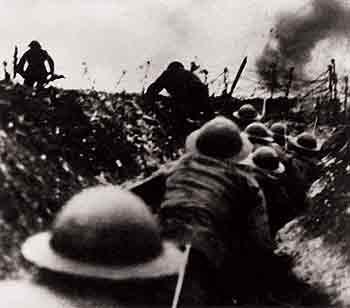
Contrast the “a game as a war” analogies, with the attitudes of the men at The Somme. I read today that some British soldiers there had a competition, to try and kick a football into the German trenches as they went for the big “push” at 7.30am. No-one claimed the prize, because all those who had competed were killed. As Roland Ingle wrote, they took chances of life and death as all being “part of the game”.
And so over ninety years the analogies are mirrored, reversed. The ball kicked over the trenches in 1916 lands at Rooney’s feet. His “shot” is fired back through the decades, and men fall over, never to stand again. We use the language of war, words like “this fateful day” and “our hero,” to describe events and people that are no such thing. The real heros have already met their fate. And now, because of The Fallen, we are free, to play a game with the Germans and the Portuguese, united by a complete triviality, the one excuse for a party. This is how we honour them.

Look, Uncle Roland! Now they are our friends.

English and German Fans mix in Cologne, before a World Cup 2006 fixture

Ben Pimlott Essay Prize

I was delighted to be shortlisted for this year’s Ben Pimlott Essay Prize, run by the Guardian and the Fabian Society. The theme this year was “on whether history can help us define British identity”.
It was great to pull together some of the ideas on Britishness I have been reading and writing about online. Tragically, I fear my essay was too much like an extended blog post with not quite enough depth… and my particular offering was pipped at the post.
Rowland Manthorpe is still a student (and a good looking one at that, dammit). His winning essay is published in today’s Guardian. Excerpts from mine will be posted to Guardian Unlimited at some point, I believe. I’ll wait for the dust to settle before discreetly posting the entire thing to this blog…
Over at The Sharpener, Paul has posted his entry, while at Ministry of Truth Unity finds a true Brit: A Pakistani immigrant, British Citizen, hoping to become the first Asian MSP by standing on a platform of Scottish Independence.

Immoral Monarchy

At qwghlm, Chris dissects the ‘myth of 62p’, the amount that the Royals cost each UK resident, each year. He rightly points out that the figure is derived from the civil list, and does not include those associated costs such as security for royal visits and weddings. I might also add that the 62p figure is derived by dividing the total cost (£37.4m) by the population of the UK (approximately 60m), whereas it should be divided by the number of taxpayers, which would yield a significantly higher figure.
While I understand the nature of Chris’ argument, I fear it will fall on deaf ears. Debates over cost will always be futile, because – as he points out, in fact – many monarchists will declare 62p to be good value for money, and would be glad to pay more.
The argument over the monarchy is an argument over the very system of politics, not value judgements over the allocation of our shared wealth and resources. The debate cannot therefore be about value-for-money, or economics. The monarchy institutionalises privilege at the very centre of our political system. It would still be immoral even if it were free. In fact, it would still be immoral if the Queen paid us to be Head of State. Cutting down the civil list, and persuading the Royals to pay tax, are mere fudges designed to give the impression of progress, where in fact none is being made. It would be more honest if Her Majesty had kept her Royal Yacht, her private jets, and locked the tourists out of Buckingham Palace. We would then look upon her as she truly is: Not some kind of A list celebrity, but as the hereditary ruler of these islands, with dominon over us all, her subjects.
Queen's Coronation

Somme Diary

Below is an excerpt from the diary of 2nd Lt. Roland Ingle, my Grandfather’s uncle, written in the days immediately preceding the start of the Battle of the Somme. In a long Sunday entry, Roland describes the ‘preliminary bombardment’, and thoughts on the imminent push.

Sunday 25th June 1916

I went up the hill again last night after mess – about 10pm; we could hear no noise down below, facing to the wind, but when I got up top, it was obvious that the bombardment was proceeding. Sharp flashes, like sheet lightnening, showed our guns firing – on right and left; our guns in front were silent just then. All along the horizon there were red flashes – not sharp and white like gun flashes, but just blazes with sometimes a little cloud above. It was, of course, a wonderful sight; flashes right and left caught your eye in quick succession. And all the time, beyond was the red burst of the shells falling on their target. I stood some time looking and two sergeants came up – we talked the usual gossip that we had all heard; any story passes these days and the funny thing is, on-one seems to mind if it is something in our favour or decidedly against us. It is a story or a rumour to carry on with – some things are true, but anyhow it is something to talk about. I have heard two distinct rumours that the anxious would find unpalatable – one , that a doctor…
… another, that our latest and most wonderful aeroplane has settled peacefully behind Hun lines. Nobody worries if they are true or not. As the time for us to move approaches, I suppose we shall be excited and nervous, but now for most people, and I should think for the most thoughtless and unimpressionable, it is just a contemplative pause and a rest. Excitement braces the muscles in healthy people, and that is the feeling you have at the thought of this ‘great push’ beginning. As I said before, as an alternative to trench warfare it is welcome – to me especially, with my doubtful powers of endurance.
Someone made the inevitable remark last night (I forgot to tell you I am in the headquarters mess of the batallion we are attached to) – that we are now taking part in what may be an historic event – for us personally, of course, historic but also possibly in years to come a historic event in The Great War. One man’s part in any move nowadays is so small that he is not likely to be nervous about the effect of his work on the final result; and fortunately the habit of “carrying on” – (that immortal phrase) – is by this time so engrained in him that in spite of great shattering of everything else he has a hope that he will be able to do it. And no-one should forget that a free throwing of yourself into a forward move gives the thing a momentum that nothing else can – beyond any mechanical discipline. If the least thoughtful could analyse his feelings, he would say, I suppose, that provided he was hitting hard he didn’t care what happened to him. And the men who are going to be knocked out in this push – there must be many – should not, certainly, be looked on with pity; because going forward with resolution and braced musceles puts a man in a mood to despise consequences; he is out to give more than he gets; he really dies fighting, and a man, who is used to sport, takes these things – even in the great chance of life and death – as “part of the game”.

britishoverthetopsomme

« Older posts Newer posts »

© 2026 Robert Sharp

Theme by Anders NorenUp ↑