Pupil Barrister

Tag: Africa (Page 3 of 6)

On How We Go To War

Amid all the frantic late night comments about the UN resolution to finally act in Libya, this tweet from @techsoc stood out:

All intervention is risky & w/ great downsides. A non-intervention is also an intervention; letting Gaddafi kill using weapons we sold.

I think this an interesting companion thought to Sunder Katwala’s bolshy piece on the subject of whattaboutery (a topic Johann Hari previously dealt with in this hardy perennial). Sunder explains why it is worth intervening in Libya when we might not do so elsewhere. First, there has to be a clear and present humanitarian crisis (this is not present in most examples of despicable oppression, a small mercy). Second, intervention has to be possible and practical. This generally means the support and assistance of major regional players like the Arab League or African Union, who are notoriously lethargic. And third, the intervention requires a legitimacy, again related to what important external stakeholders think, but also what those inside the country ask for. These three checkboxes provide a case for what Sunder calls contextual universalism. It matters – at least to me – because it articulates why I had a gut feeling that the Iraq war was wrong, and the current intervention is right. This is despite the fact that the documented brutality of Saddam Hussein was ever bit as bad as that of Colonel Gaddafi.
The cautious approach is clearly a response to the bungling of Iraq. I watched some of the collegiate House of Commons debate on the issue yesterday, and most of the contributions, from Nicholas Soames to John McDonnell, were infused with the considerations that Sunder lays out. This approach to Foreign policy – the need for practicality and legitimacy, the need to be seen to be going to war for the right reasons – is obviously influenced by how unsuccessful the hawkish and shameless approach of Bush/Blair turned out to be. in 2006 I wrote in this space how protest actually serves to influence future policy more than current policy. I quoted Tim Ireland of Bloggerheads, who wrote:

… someone has to be called to account or the next batch of power-mad bastards – here or abroad – will think they can get away with exactly the same thing.

Well, Tony Blair was not forced kicking and screaming from office in the way Tim hoped. Nevertheless, the way the British and American Governments have acted during this current crisis is telling. It is clear that they have been profoundly affected by the uproar we caused last time. David Cameron is rightly being praised for his handling of the crisis, but his course of action was defined by the parameters set for him by recent history. And those parameters were set by us, the awkward squad of protesters and dissenting bloggers. For that, I think we can claim some credit.

Update

I did not see The Andrew Marr Show but @DrEvanHarris did:

Shami points out Blair Iraq effect coming home to roost. No public appetite for deploying ground troops even in humanitarian cause. #marr

Chimanmanda Adichie's Single Story

An interesting TED talk by the novellist Chimamanda Adichie on the power of stories, and how a multitude of stories are required in order to fully understand other people.

Key quote is thirteen minutes into the speech:

I have always felt that it is impossible to engage properly with a place or a person, without engaging with all the stories of that place and that person.  The consequence of the Single Story is this: It robs people of dignity.  It makes our recognition of our equal humanity difficult.  It emphasises how we are different, rather than how we are similar.

That’s my kind of multiculturalism.

Guardian Gagged

Houses of Parliament at dusk. Photo by yrstruly on Flicker (CC licence)

Houses of Parliament at dusk. Photo by yrstruly on Flicker (CC licence)


This cannot be left without comment:

Today’s published Commons order papers contain a question to be answered by a minister later this week. The Guardian is prevented from identifying the MP who has asked the question, what the question is, which minister might answer it, or where the question is to be found.
The Guardian is also forbidden from telling its readers why the paper is prevented – for the first time in memory – from reporting parliament. Legal obstacles, which cannot be identified, involve proceedings, which cannot be mentioned, on behalf of a client who must remain secret.

If it is any consolation, the order papers are in the public domain1, so those with a mind to do so have followed the trail.  The consensus on Twitter and the blogs is that it refers to this question:

Paul Farrelly (Newcastle-under-Lyme): To ask the Secretary of State for Justice, what assessment he has made of the effectiveness of legislation to protect (a) whistleblowers and (b) press freedom following the injunctions obtained in the High Court by (i) Barclays and Freshfields solicitors on 19 March 2009 on the publication of internal Barclays reports documenting alleged tax avoidance schemes and (ii) Trafigura and Carter-Ruck solicitors on 11 September 2009 on the publication of the Minton report on the alleged dumping of toxic waste in the Ivory Coast, commissioned by Trafigura.

Thanks to The Third Estate for doing the legwork.
It would be no surprise if these extrapolations turn out to be true.  The Guardian has been following the Trafigura story for months and reported in May on the dumping of toxic ‘slops’ in the Ivory Coast.  The theory is that the paper wanted to publish details of the Minton Report by consulting scientists MTD.   The report recently appeared on Wikileaks.
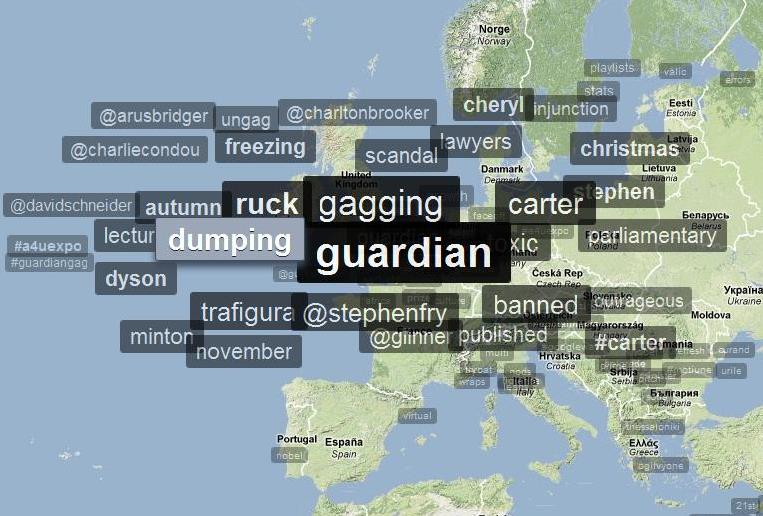
This is also another example of the Streisand effect in action.  The fascinating TrendsMap shows that the words ‘Trafigura’, ‘Dumping’, ‘Gagging’ and ‘Guardian’ are the most talked about keywords. As @alexmassie says on Twitter:

Had never heard of Trafigura until they tried to ban the reporting of parliamentary proceedings. Fools.


1. As an aside – The House of Commons website is bloody awful. Anyone using the official record for any reason is likely going to want to cite a particular column, line, or question, rather than an entire webpage. The list of questions should be properly numbered so I can link direct to the part I want – in this case, question 61.

Why They Cheer

There has been plenty of outrage over the release of Lockerbie Bomber Abdelbaset al-Megrahi. The scenes of him arriving in Libya to a hero’s welcome have provoked disgust in the UK.
Why cheer a terrorist? It’s worth considering the situation from the Libyan point of view. First, al-Megrahi’s conviction was not water-tight. The manner of his identification by a witness in Malta was, I recall, highly irregular. I remember seeing a documentary about the case last year, which made me worry about the certainty of the conviction. And if Ordinary Britons are uneasy about the case, you can bet that Ordinary Libyans will be too. The conventional narrative there will be akin to that of the Guantanamo detainees – a Western power pursuing a vendetta against and unfortunate scapegoat.
This doesn’t take al-Megrahi’s side, or excuse Libya’s stte terrorism. But it does give an alternative explanation for the crowd’s exhuberance. It is more an expression of Libyan nationalism, than simply barbarians cheering a murderer.

« Older posts Newer posts »

© 2026 Robert Sharp

Theme by Anders NorenUp ↑