Let 2009 be safe and productive for everyone.
New Year’s resolutions include writing: more blog posts, and some creative writing too. In fact, an early blog post is likely to be a lament on lost pieces of creative writing, and the futile attempts to recreate an early, imagined genius.
Tag: Diary (Page 16 of 30)
Now permalinks are the norm, its unusual to lose anything you’ve written online. We are Funes. However, now CSS is also the norm, it is possible to lose the design of any given page. For example, the posts from my archives which announce a re-vamped site design have been rendered pretty meaningless after I re-re-designed the site earlier this year. Having said that, my latest, lazy template does attempt to retain some elements of the old design, on pages that previously carried it. A web designer with more coding skills than me should create a WordPress plugin that allows older posts to use a different template for older posts.
And of course, some websites no longer exist. Permalinks only work if you’ve remembered to pay your hosting invoice. Graphic Designer Jason Santa Maria has asked his readers to post examples of their early websites (via Kottke):
The things we write are published with a specific design and context. When we change that, we break the context and alter the original qualities of that piece of work… We haven’t had enough time to step back and see web design objectively. Will the work we’re doing have historical significance? Sure. Will it have historical significance in design? Probably.
Its definitely the case that web design “dates” just like conventional print graphic design. When I reviewed the Presidential websites earlier in the year, I noted how Barack Obama’s logo and website seemed to be very much of-the-moment. (Given his recent victory, perhaps we have a new predictor for elections: The candidate with the most modern website design wins?)
Anyway, my earliest experiments in HTML is illustrated below. The site was a scrapbook for the year I spent living in Zimbabwe (back when Robert Mugabe and Tony Blair were still friends). It carried a few cute and now totally outmoded innovations, such as a counter and a guestbook. It did include some early experiments in CSS, but the menus committed the double crime of being images, and utilising some italicised version of Comic Sans. Oh, the shame of it!

My first website, using rudimentary CSS and an ill-advised use of Comic Sans
Another page that is still online is a failed pitch for a gallery installation. It is an example of Single Serving Site, before that phrase was coined.
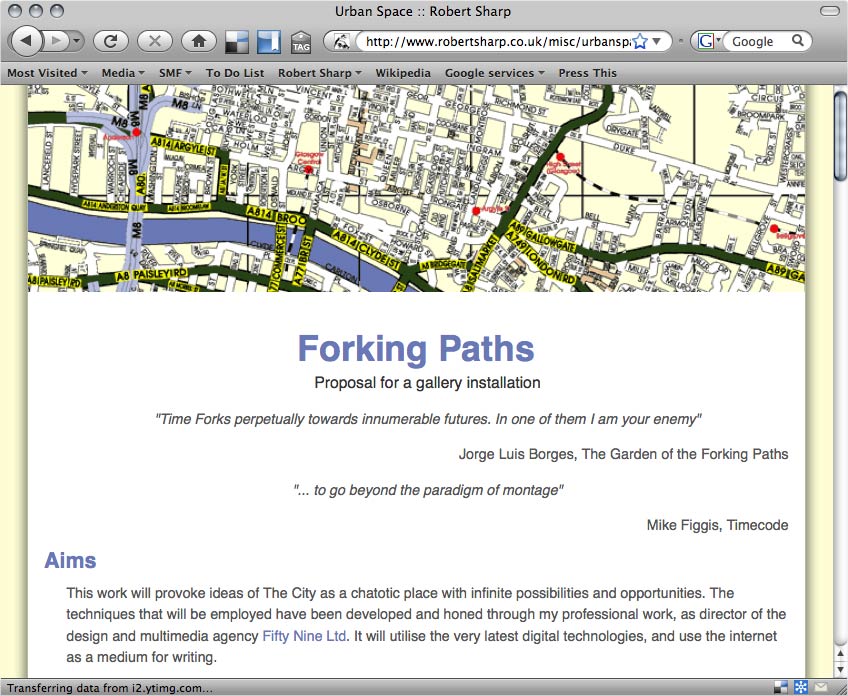
Forking Paths – An online proposal for a piece of art
I’ve added a gallery of a few more old sites below.
Continue reading
I took this photo a couple of days ago:

Plaque commemorating those who lost their lives in the Lewisham Train Disaster, 4th December 1957
Continue reading
I managed to get down to the Cenotaph last Tuesday for the Armistice Day ceremony. However, I did not manage to post any kind of tribute on the blog. Better late than never, here are a few thoughts.
Whitehall runs through Westminster on a North-South axis, with Parliament Square and the Palace of Westminster immediately to the South. Since its a road in the Northern Hemisphere, this means that during a mid-morning in November, the sun will be low in the sky behind the Victoria Tower. Tuesday was crisp and clear, and as Big Ben struck eleven o’clock last Tuesday, the sun peaked out from behind some lingering cloudes and streamed down Westminster. North of the Cenotaph, we onlookers raised our hands to our heads, to sheild our eyes from the glare. An unwitting, yet entirely fitting, civilian salute to the dead.

Onlookers at the ceremony to mark the 90th Anniversary of the end of the Great War 1914-18. 11th November 2008
For me, I always find the moment when music breaks the silence to be the most moving. Bag-pipes, so often derided as a nuisance on the Edinburgh Royal Mile, find their niche at these sombre moments. A brass band, a Welsh male voice choir, and a poem by Siegfreid Sassoon, Have You Forgotten Yet?
That word, that “yet”, challenges us. Sassoon knows that we will forget, eventually, and the men who died at The Somme and elsewhere will eventually be known to us only as nameless fodder, much like the thousands who died at Waterloo. Too far back in history to be properly human. But no Seigfried, not yet, not while three men who fought in that war still roll down Whitehall in their chairs.
Who do we forget first? Those young unmarried men without descendants, that’s who. It is a crass, Darwinian truth that, for the most part, we are a nation descended from the survivors of war, not the fallen. Its telling that the two poppies I planted in the Westminster Abbey Garden of Remembrance, I planted not for grandfathers, but for two distant uncles: 2nd. Lt. Roland Ingle, who I’ve written about before, and Flt. Lt. Reginald Rimmer, blown up over Burwash, East Sussex, during the Battle of Britain, 1940.
You silly, silly young men! Positively eager to go-over-the-top. Stubbornly climbing back into the cock-pit. Zealous, brave, and long dead by the time you were my age: Thank you.

Tributes in the Garden of Remembrance, Westminster Abbey, London. 11.11.2008. Photo by yrstrly
There’s no free wifi here in Birmingham. Clearly the Tories expect to pay privately for that kind of public service, whereas last week at the Labour Conference in Manchester, the connectivity was subsidized.
Also missing is the air of triumphalism that I expected would greet us on arrival. Instead there is a real sense of caution. Steady as she goes, show some humility, master the brief… and wait for Labour to implode.
I experienced a couple of Down the Rabbit Hole moments at the Labour Conference last week. The first was on Monday morning at the Public Sector 2.0 fringe event, which was broadcast into Second Life. My avatar watched the screen, which depicted a room in which I was sitting, looking at my laptop.

Public Sector 2.0
The second moment was when I spotted the Prime Minister and his wife coming out of the lift, on their way to deliver their eagerly awaited speeches (I half expected them, as I had almost bumped into them coming out of a lift earlier that afternoon). They disappeared out the front entrance… and immediately appeared on the screens that had been set up in the foyer. In this era of mass communication, the barriers between the screen and real life are sometimes very blurred.

The Prime Minister in the foyer, and the screen, and someone's head
The speech itself did what it what supposed to do, which was bouy the Party Faithful and fight off a leadership challenge. But one week later, and the positive feelings fade. Danny Finkelstein is right: Labour thinks the voters are wrong, or misguided, or don’t realise what the Party has done for the Country. His advice:
It started with a simple proposition – it wasn’t enough for the party to understand that voters had lost faith in us. We had to do something far harder. We had to accept deep within us that this loss of faith was justified.
When I read something like Justin McKeating’s shopping list of Labour’s failures, panderings and hypocrisy, its difficult to disagree with the proposition that Labour are out of touch. Perhaps the current economic crisis will draw them back to reality – in this case, the populist, protectionist approach doesn’t quite seem so vile, although some libertarian bloggers may disagree.