The Convention on Modern Liberty has invited its attendees to post video responses to the messages that their key speakers have created in support of the project. I’ve had a go, and created an archetypal ‘head to camera’ YouTube video:
My take is to highlight the problem of small, minor liberties being taken away without comment. If we guard against the loss of these, then the large incursions onto our freedoms, the kind that bring about a totalitarian state, will never happen. But those freedoms are also valuable in themselves.
I am slightly uneasy about saying that the large infringements, such as the 42 days detention laws, or the existence of Guantanamo, are somehow ‘abstract’. Some might see this as an insensitivity to those who have fallen victim to such state-sponsored action… and that may indeed be the case. However, my aim in making the video (or rather, making the point) was to provide a persuasive argument that may convince people that remain ambivalent, rather than a place to show anger, solidarity, or both.
I think that feature has come to be the tone of this site over the past, say, twenty months. I’ve found this is less a place to rant, less a place for me to find catharsis… and more a place to push an argument into new places. If it appears to some people that I have missed the point, then there’s a chance that the argument wasn’t intended for them in the first place.
Tag: Internet Philosophy (Page 24 of 39)

Seventh volley, Harrington vs Anderson (12th Oct 2007)
Hooray. Layer Tennis is back for another season.
My thoughts on its delights and the Age of the Remix are to be found here.

Clay Shirky at Demos, 14 July 2008. Photo by Lloyd Davis
A few months ago, sociologist Clay Shirky spoke at a Demos event around the launch of his book, Here Comes Everybody. Irritatingly, I missed the event, but did download the handy podcast. In a question about “how to use the web to make a documentary about the web, he had this to say:
If you’re making a web documentary about the future of the web, you can open it up for digital production. You can say, “make a video of yourself, talking about what you think the future will be like, or show me what you are doing, document this somehow, and send this to me as raw material.”
You can harness people for the outlet: “I’m doing a video documentary on the web and we’re going to launch it on One Web Day (or some such event), and we’re going to host virtual salons where people are going to get together to view this thing” and you can find the audience [via the web].
But the really interesting bit I think is this sort of ‘A&R plus Remix’, which is: how many versions of a documentary could there be? Because the choice for all of this stuff is, “here’s the main thread, right” but then there’s always going to be people who want more of X and less of Y. Is there a way to let people who are interested in, say, the change in music culture, have a documentary that, while keeping true to the through-line, has more of that aspect? And then for people form whom transformation of the political environment [is most interesting], you have more of that aspect instead.
And so that, it seems to me, is the really interesting thing – looking at essentially raw material; discovery; production; and distribution… and figuring our whether you can use the web at all of those touch-points.
I know the Convention on Modern Liberty will be extensively filmed. All the plenaries and breakouts will be recorded and podcast, and the main speeches will be streamed live. Some of the keynote speakers have already recorded their own thoughts in short pieces-to-camera, and the organisers have invited the public to post video responses.
Moreover, the range of freedoms under threat, and indeed the number of competing definitions of what “Modern Liberty” actually means, suggest to me that the Convention is a ripe subject for a Documentary-Plus-Remix, along the lines Shirky describes above.
I’m proud to have been drafted in to help the Convention on Modern Liberty create a new design for their – our – WordPress website.The site will be updated tomorrow to reflect the changes.
Another site to launch recently is LabourList, a party blog that has managed to draw many senior government and party figures to contribute. It went for a “soft launch” last week, and currently carries the notice
Beta Test Site – Official Launch 12th February 2009
However, that hasn’t stopped folk like Iain Dale writing reviews of the site, run by Derek Draper, pointing out its failings as a worthy challenger to ConservativeHome and its ilk on the political right.
As a director of 59 Productions, I was (until 2007) involved in many a theatrical production, ranging from site-specific work in Scotland to high-budget productions at the National Theatre and the London Coliseum. With all these productions, it was standard practice to have one or more preview shows, effectively public dress rehearsals, where not only were creases ironed out of the staging, but often entire scenes were cut or reworked to make it more effective. Beta-testing for live performance. In each case, critics understand the fact that the previews do not necessarily represent the production in the way the director envisages. They respect the effective embargo (to borrow a term from press releases) on reporting and reviewing the performance. They wait until opening night.
It is perhaps a sign that the act of blogging is still in its immaturity, that the concept of holding off on judgement is not applied to the launch of blogs and websites, in the same way as it is for other forms of expression.
Now permalinks are the norm, its unusual to lose anything you’ve written online. We are Funes. However, now CSS is also the norm, it is possible to lose the design of any given page. For example, the posts from my archives which announce a re-vamped site design have been rendered pretty meaningless after I re-re-designed the site earlier this year. Having said that, my latest, lazy template does attempt to retain some elements of the old design, on pages that previously carried it. A web designer with more coding skills than me should create a WordPress plugin that allows older posts to use a different template for older posts.
And of course, some websites no longer exist. Permalinks only work if you’ve remembered to pay your hosting invoice. Graphic Designer Jason Santa Maria has asked his readers to post examples of their early websites (via Kottke):
The things we write are published with a specific design and context. When we change that, we break the context and alter the original qualities of that piece of work… We haven’t had enough time to step back and see web design objectively. Will the work we’re doing have historical significance? Sure. Will it have historical significance in design? Probably.
Its definitely the case that web design “dates” just like conventional print graphic design. When I reviewed the Presidential websites earlier in the year, I noted how Barack Obama’s logo and website seemed to be very much of-the-moment. (Given his recent victory, perhaps we have a new predictor for elections: The candidate with the most modern website design wins?)
Anyway, my earliest experiments in HTML is illustrated below. The site was a scrapbook for the year I spent living in Zimbabwe (back when Robert Mugabe and Tony Blair were still friends). It carried a few cute and now totally outmoded innovations, such as a counter and a guestbook. It did include some early experiments in CSS, but the menus committed the double crime of being images, and utilising some italicised version of Comic Sans. Oh, the shame of it!

My first website, using rudimentary CSS and an ill-advised use of Comic Sans
Another page that is still online is a failed pitch for a gallery installation. It is an example of Single Serving Site, before that phrase was coined.
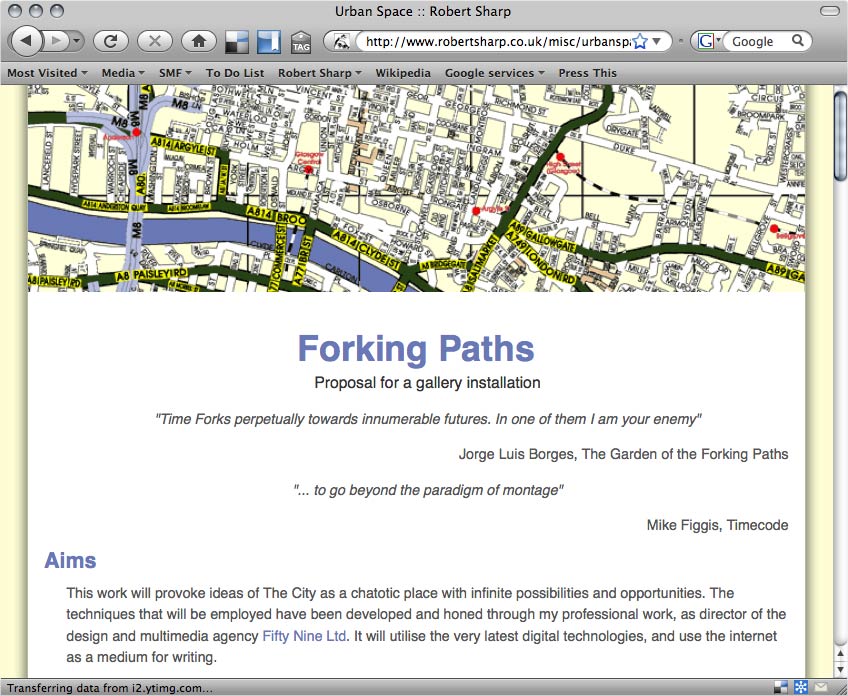
Forking Paths – An online proposal for a piece of art
I’ve added a gallery of a few more old sites below.
Continue reading