Clive Thompson in Wired, on How Twitter Creates a Social Sixth Sense:
Individually, most Twitter messages are stupefyingly trivial. But the true value of Twitter is cumulative. … When I see that my friend Misha is “waiting at Genius Bar to send my MacBook to the shop,” that’s not much information. But when I get such granular updates every day for a month, I know a lot more about her. And when my four closest friends and worldmates send me dozens of updates a week for five months, I begin to develop an almost telepathic awareness of the people most important to me.
Twitter is a kind of mini-blogging, where you can post message via text message. Thompson predicts that this feature will be incorporated into other applications… and indeed, a similar feature exists in Facebook, which incorporates a “status” field that you can fill in with whatever you wish.
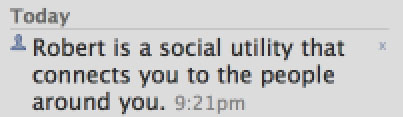
One feature of the Facebook feature is that the site automatically adds the word “is” to the start of the sentence (i.e. “Robert is…”). This can be frustrating when one’s status (whatever it may be) does not lend itself well to an “is”. I have to write “Robert is wanting…” instead of “Robert wants…”, and “Robert is thinking…” instead of “Robert thinks…”
Some people have been agitating to have this little quirk removed from the site. However, I think this would be a mistake. Sometimes, real creativity arises when one has to overcome constraints. Some of the best Facebook statuses (stati?) I’ve seen, have caused the obligatory “is” to be integral. When you realise that the first two words of a sentence are mandatory, a cliche suddenly seems inspired.
My recent favourites are both very much the epitome of 21st century urban life:
Gill is like, so, whatever.
and
Mike is just popping out to the shops, do you want anything?


