Barrister

Author: Robert (Page 294 of 328)

Somme Diary

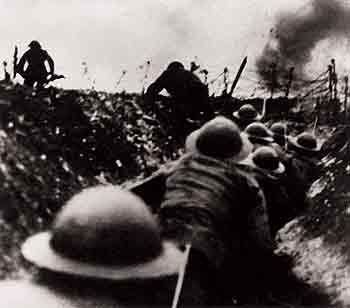
Below is an excerpt from the diary of 2nd Lt. Roland Ingle, my Grandfather’s uncle, written in the days immediately preceding the start of the Battle of the Somme. In a long Sunday entry, Roland describes the ‘preliminary bombardment’, and thoughts on the imminent push.

Sunday 25th June 1916

I went up the hill again last night after mess – about 10pm; we could hear no noise down below, facing to the wind, but when I got up top, it was obvious that the bombardment was proceeding. Sharp flashes, like sheet lightnening, showed our guns firing – on right and left; our guns in front were silent just then. All along the horizon there were red flashes – not sharp and white like gun flashes, but just blazes with sometimes a little cloud above. It was, of course, a wonderful sight; flashes right and left caught your eye in quick succession. And all the time, beyond was the red burst of the shells falling on their target. I stood some time looking and two sergeants came up – we talked the usual gossip that we had all heard; any story passes these days and the funny thing is, on-one seems to mind if it is something in our favour or decidedly against us. It is a story or a rumour to carry on with – some things are true, but anyhow it is something to talk about. I have heard two distinct rumours that the anxious would find unpalatable – one , that a doctor…
… another, that our latest and most wonderful aeroplane has settled peacefully behind Hun lines. Nobody worries if they are true or not. As the time for us to move approaches, I suppose we shall be excited and nervous, but now for most people, and I should think for the most thoughtless and unimpressionable, it is just a contemplative pause and a rest. Excitement braces the muscles in healthy people, and that is the feeling you have at the thought of this ‘great push’ beginning. As I said before, as an alternative to trench warfare it is welcome – to me especially, with my doubtful powers of endurance.
Someone made the inevitable remark last night (I forgot to tell you I am in the headquarters mess of the batallion we are attached to) – that we are now taking part in what may be an historic event – for us personally, of course, historic but also possibly in years to come a historic event in The Great War. One man’s part in any move nowadays is so small that he is not likely to be nervous about the effect of his work on the final result; and fortunately the habit of “carrying on” – (that immortal phrase) – is by this time so engrained in him that in spite of great shattering of everything else he has a hope that he will be able to do it. And no-one should forget that a free throwing of yourself into a forward move gives the thing a momentum that nothing else can – beyond any mechanical discipline. If the least thoughtful could analyse his feelings, he would say, I suppose, that provided he was hitting hard he didn’t care what happened to him. And the men who are going to be knocked out in this push – there must be many – should not, certainly, be looked on with pity; because going forward with resolution and braced musceles puts a man in a mood to despise consequences; he is out to give more than he gets; he really dies fighting, and a man, who is used to sport, takes these things – even in the great chance of life and death – as “part of the game”.
britishoverthetopsomme

Alaa Free

Funny how the same words, in a different order, mean vastly different things. Last month I blogged about the Free Alaa campaign, an online drive to raise awareness of the detention of Egyptian blogger and democracy activist Alaa Abd El-Fatah. I heard about his detention via blogging, and by the same methods (via Adloyada) I now hear he has been released.
Part of the campaign was a GoogleBomb, whereby bloggers attempted to fool Google into returning pages from the Free Alaa campaign site, whenever the word ‘Egypt’ was searched for. As Adloyada suggests, this particular tactic may have had minimal effect, but the wider use of the internet as a medium for campaigning is what interests me here.
We are updated regularly on the ‘explosion’ of blogging, with about a billion new blogs created daily. Many of these – arguably the more interesting ones – are likely to spring up in places where democracy and human rights are not guaranteed. I worry that examples of bloggers being detained, already a regular occurence in Iran, will increase with the popularity of blogging in general. Perhaps we will begin to see a form of campaign fatigue, whereby it is difficult to keep track of which bloggers have been detained, and where!
This is where Web 2.0 innovations such as wikis and RSS feeds can come into their own, ensuring we can keep updated and active over a lengthy period of time. Metaphorical ideas of momentum and critical mass are crucial factors in political movements. It will be interesting to see whether technology will lead to more sustained and effective campaigns, or just higher-profile, yet ultimately damp, squibs. Looks like the former in the case of Alaa, thank goodness.

Ebenezer

Following my post regarding names and over-achieving name-alikeys, a correspondent of mine writes:

I wanted to call my son Ebenezer. I wanted him to have a unique name, and I don’t know any other kids called that. When he grew up, he could shorten it to ‘Ben’ if he wanted, or if he fancied something a bit more street, he could call himself ‘Ezey’, like if he was a DJ or something. It would be a good stage name. It would look good on a book jacket. Everyone he met would remember him. He would be talked about. People would say “Do you know Ebenezer?”
…
But my wife wasn’t having any of that. She said that kids at school might bully him. So instead we named him John, after my Dad. My son John, who must now compete for attention with the billions of other Johns out there.

Earlier this year, sitting on a bus winding through the hills of Sri Lanka, I met a British couple who were expecting a baby. He was a Scotsman, while she was of Sinhalese Sri Lankan parentage. They were discussing what name to give the baby. Part of the discussion was to find a combination of first and middle names which acknowledged their disparate heritage. Would the child take on the father’s monosyllabic Scottish surname, it’s mother’s polysyllabic Sri Lankan second name, or a hyphenated tongue-twister which combined the two? I wondered to what extent the origin of the name would affect the child’s relationship to the world around them. In those weeks before a decision was made, the baby had as much chance of being named Christopher or Angus, as being named Dilip, or Hasantha. Born into the twenty-first century UK, he would not, I hope, suffer any prejudice, had his parents chosen the latter moniker. However, it would serve as a constant reminder of his heritage in a far-off continent. What effect would this have on his approach to life, his politics, his “identity”? I imagine it would be quite significant, and positive. EbenezerJohn’s father clearly agrees… as did Johnny Cash when he wrote “A Boy Named Sue”.
Or; Would Cassisus Clay have won as many fights as Muhammed Ali?

So. Farewell then, Harriet the Tortoise

Harriet the Tortoise has died at the age of 175.
During the recent celebrations for her 175th birthday, her keepers at the Australian zoo put her longevity down to a “stress free life.” However, existence was not always easy. After being brought over from the Galapagos (perhaps by Darwin?) she was unfortunately designated male, and had to spend a hundred and twenty five years being treated as such.
The ignominy of this administrative error must have been especially acute for Harriet, because Tortoises are a sign of the feminine in some cultures. A colleague of mine has an ambition to visit the Yunnan province in China, to search for the feminine symbols carved onto tortoise shells (with, she writes, “the express blessing of the tortoise, of course”).

Ghost

A few months back, I wrote about the ghosts in the ipod, who swim about in the diodes and relays of your MP3 player, and choose songs which somehow soundtrack your mood. It is interesting to gaze upon an old, familiar sight, and yet feel new emotions, even notice new things, because the accompanying soundtrack has changed.
A few days ago, I attended a quirky piece of theatre titled Ghost, produced as part of the Leith Festival. Arriving at the venue, you are presented with a small MP3 player and headphones, and sent off onto the streets and schemes of Leith. A narrator allows his story to unfold, while you are told which paths to follow by a robotic, feminine ‘GPS’ guide named Thanos. As you walk past random pedestrians, and sullen truants, you realise you are part of a clandestoine world which those around you cannot access. When you do spot another ‘theatre-goer’, you let slip a conspiratorial smile. Their identical MP3 headphone set is like the badge of a secret society.
The story is one of love, loss and flight, but is not without wit. References to an Icarus-like fall from the Heavens are complimented with a pair of angel wings, discarded in a tree in a church-yard. It is as if William Blake’s angels in the trees have had a nasty mid-air collision. Soon after, the narrator (a Daedalus figure) declares that he has invented the ‘cyborgs’ who walk around you. Look, notice! The man on his mobile phone, or the others with wires coming out of their ears. All robots, following the complex programming they have been hard-wired to follow. It is at this point that you are struck by the realisation that you, too, are following a pre-ordained path around the city. The production company is Puppet Lab: they have created a show where the audience and the puppets are one.
Continue reading

« Older posts Newer posts »

© 2026 Robert Sharp

Theme by Anders Noren — Up ↑