Robert Sharp

Pupil Barrister

Page 216 of 328

From the Archives

Now permalinks are the norm, its unusual to lose anything you’ve written online. We are Funes. However, now CSS is also the norm, it is possible to lose the design of any given page. For example, the posts from my archives which announce a re-vamped site design have been rendered pretty meaningless after I re-re-designed the site earlier this year. Having said that, my latest, lazy template does attempt to retain some elements of the old design, on pages that previously carried it. A web designer with more coding skills than me should create a WordPress plugin that allows older posts to use a different template for older posts.
And of course, some websites no longer exist. Permalinks only work if you’ve remembered to pay your hosting invoice. Graphic Designer Jason Santa Maria has asked his readers to post examples of their early websites (via Kottke):

The things we write are published with a specific design and context. When we change that, we break the context and alter the original qualities of that piece of work… We haven’t had enough time to step back and see web design objectively. Will the work we’re doing have historical significance? Sure. Will it have historical significance in design? Probably.

Its definitely the case that web design “dates” just like conventional print graphic design. When I reviewed the Presidential websites earlier in the year, I noted how Barack Obama’s logo and website seemed to be very much of-the-moment. (Given his recent victory, perhaps we have a new predictor for elections: The candidate with the most modern website design wins?)
Anyway, my earliest experiments in HTML is illustrated below. The site was a scrapbook for the year I spent living in Zimbabwe (back when Robert Mugabe and Tony Blair were still friends). It carried a few cute and now totally outmoded innovations, such as a counter and a guestbook. It did include some early experiments in CSS, but the menus committed the double crime of being images, and utilising some italicised version of Comic Sans. Oh, the shame of it!

My first website, using rudimentary CSS and an ill-advised use of Comic Sans

My first website, using rudimentary CSS and an ill-advised use of Comic Sans


Another page that is still online is a failed pitch for a gallery installation. It is an example of Single Serving Site, before that phrase was coined.
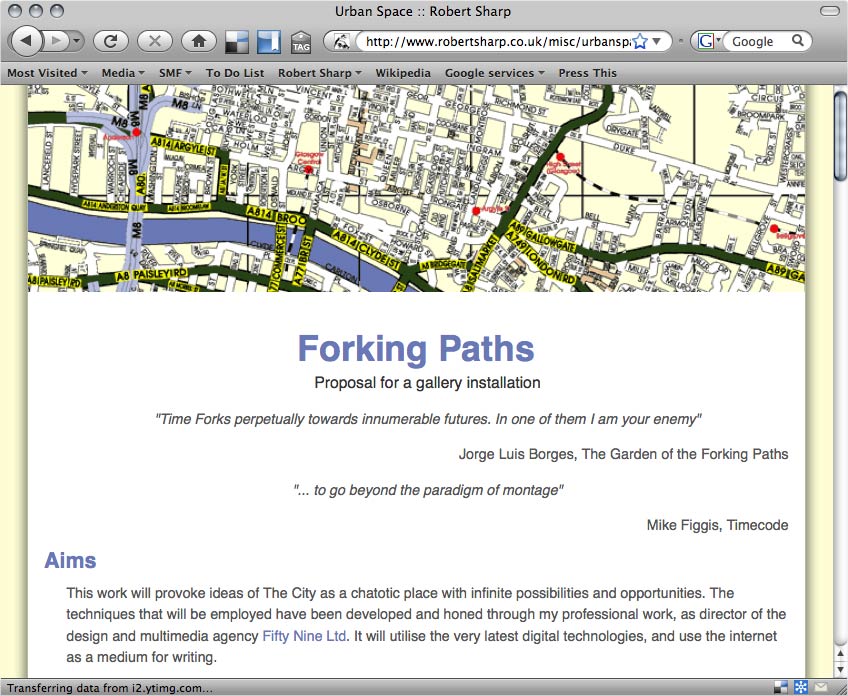
Forking Paths - An online proposal for a piece of art

Forking Paths – An online proposal for a piece of art


I’ve added a gallery of a few more old sites below.
Continue reading

Notes on the VAT rebate

Westfield Shopping Centre, Shepherd's Bush, London

Westfield Shopping Centre, Shepherd’s Bush, London


In recent weeks, many have been mocking at Alistair Darling’s 2.5% reduction in VAT.  It amounts to a measly two pennies in every pound, so they say, and is hardly likely to stimulate spending in the waythe Chancellor so desires.  Who would cross the road for a 2% off deal?
Having run a small business, I can also say that a 2.5% change in VAT is not small change for everyone.  Business-to-business transactions all require VAT to be charged (regardless of whether it is claimed back every quarter).  A reduction of 2.5% on a five- or six-figure contract equates to hundreds or thousands of pounds, respectively.  That could easily represent difference between solvency and insolvency.
Wandering around the expansive, yet surprisingly pleasant Westfield Shopping Centre yesterday, I marvelled at the legions of people flooding into the designer outlets, and tried to imagine how much money was beiung exchanged.  I began to think that the critique of Darling’s VAT adjustments might be missing some maths.  Or at least, some psychological insights into how people spend money.
It is not that we will notice the cheaper prices, and therefore go out and buy more of the “discounted” items.  We will not.  However, its a fact that if we maintain our current levels of spending, on similar items as we did before the VAT change, then we will be left with a little but of money left over at the end of the month.  If a person on an average wage of £24,000 spends, say, half his or her salary in a given month, all on VATable items, then that amounts to about £16 extra each month.  If that average person is anything like me, they will indeed spend it.  Why?  Because me and the average guy do not budget very well.  The amount we save each month will probably be predetermined by standing order (perhaps even siphoned off into a pension scheme, for all the good that would do in this perilous financial climate).   And as for the rest, well, we just keep spending on a whim until we reach a certain level. This threshold will be different for each person:  It might be the point at which the bank account reaches its over-draft limit, or when the sight of the balance falling into single figures induces panic.  Regardless, this threshold will be met when sixteen extra pounds have been spent (or whatever the figure actually is).     If most people operate like this, then an extra few quid – equivalent to an extra evening a month in the pub, say – ends up in circulation.  That’s a lot of money in the economy.

Sketching Michelle O

The second big question facing the United States at the moment (the first is what dog the Obama’s should get) is of course, what Michelle Obama should wear to the inauguration and its myriad balls, in forty days time.

Sketch by Isaac Mizrahi


Via Kottke, here is an interesting array of proposals for Mrs Obama, from some of America’s top fashion designers. I particularly like the sketches that include proposals for the two daughters, Malia and Sasha: They really capture that slightly timid but proud gait that all three women exhibited when they walked out with the President-Elect on election night.
From WWD.com, by Zero + Maria Cornejo

From WWD.com, by Zero + Maria Cornejo


The final sketch caught my eye. I don’t particularly like the red dress, but the mannequin features of the sketch are very similar to the androgynous fairy I created for an experimental animation a while back:

On Trolls, Liberty, Debate and Damian Green

There’s a recently concluded debate over at the Liberal Conspiracy about ‘feeding the trolls’, that is, engaging with commenters on the blog who are just there to provoke an argument. I think there is a distinction between proper trolls, who are actively seeking to waste their own time in order to waste others’, and other people who simply have a wildly differing worldview. In the case of the former, it is rarely worth engaging. But in the case of the latter, debate can sometimes be helpful. It all depends on what kind of conversation you want to have, and on the Liberal Conspiracy, it is often impossible to talk about something at the level of detail you desire, if you are arguing first principles with someone else (be it a troll, or bona fide member of the seething classes).
Sometimes, I wonder if the mainstream media aren’t trolling. Today I spotted this headline from the Daily Mail, and feel confident that it has been written to waste my time.

Human Rights: Straw To Get Tough
Exclusive – Minister tells Mail how he’ll reform ‘Villiain’s Charter

Its not that I do not disagree with the idea of labelling the Human Right’s Act a “villiain’s charter”.  Its just that attempting to engage with it – especially on a blog – is a bit pointless. Its not as if they are making some kind of technical or categorical error that a plucky blogger might tease out and add to the debate. This article is speaking a genuinely different language. I have been silent on the ‘Baby P’ issue, because the debate was of this highly toxic, divisive type. Others gamely engaged with the trolls, so to speak, but there comes a point where its down to someone with a little more profile that bloggers to take up the political fight. This is why people often end up criticising political allies, for relatively trivial reasons, apparently missing the wood for the trees. Its not that we’ve lost our moral compass, just that we’re angry that other people are not speaking up for us in the places that matter.
As to the substance of the article, I’ll merely note again that it is the hated and the vulnerable who have their Human Rights violated first. The Declaration of Human Rights was created precisely to guard against populist tendencies in governments. They’re inconvenient, but then so is the task of retaining our humanity in the face of violence and antagonism.
For those with a fatigue for this sort of thing, I highly recommend a visit to the ‘Taking Liberties‘ Exhibition (no, not that Taking Liberties) at the British Library. It has the Magna Carta and other declarations of Rights and Freedoms penned by various men and women from around these isles.
The exhibition set me thinking about the Damian Green affair (something else that seems so divisive that there is so little common ground between the warring parties that debate seems futile). Whilst I personally don’t believe that Jacqui Smith ordered the police into Mr Green’s office, and I do not believe that the Speaker, Michael Martin, colluded in the warrantless searching of the Tory MP’s office, the outcry itself seems like a healthy thing to me. It is good that there is an ‘awkward squad’ barrage of questions every time there is any hint of impropriety. Far from us living in a Stalinist State, as some alledge, it is the indignant calls to account which prevent us sliding into one.

Update

Heh – I wrote:

its down to someone with a little more profile that bloggers to take up the political fight

Ask and it shall be delivered unto you.

« Older posts Newer posts »

© 2026 Robert Sharp

Theme by Anders NorenUp ↑