Last Friday night I spent an interesting evening with the folks from the Tactical Technology Collective, who show communities and campaigning groups how to use new technologies to their advantage. I’ve long been a fan, because I think that their NGO in Box project (in its several iterations) is a simple idea that’s probably extra effective because of good design.
We were at the Frontline Club in Paddington for the screening of their documentary, 10 Tactics, which gave real world tips for digital advocacy. The tactics include presenting a visual message, using humour and animation to reach difficult groups, and amplifying personal stories to make a more effective message. We saw what free and open source tools were available to do this.
Much of the film focused on working in developing countries, where IT technologies are still emerging and people don’t have information at their fingertips. Many of the tactics have information delivery as an end in itself, for example, telling Zimbabweans where to vote or rural farmers in India where to find information on their land rights. This direct communication with what charities might call their “beneficiaries” is very different from many UK charity campaigns, which tend to be about raising awareness of a problem amongst people who are not suffering from it (in the case of PEN, say, we spend a fair amount of time campaigning to let our members in the UK know about the censorship and persecution of writers overseas). I would describe this type of campaigning as presenting a second order message (not “do this” but “do this for other people”) or even a third order message (“the government should do this for other people”) – I’m sure hardened charity campaigners have a more sophisticated taxonomy for these different types of message. One criticism I heard about 10 Tactics is that it did not offer enough advice for this second and third order campaigning. Perhaps we need another film which explains how to call people in the UK to action. Or maybe that’s a red herring, and the need for direct first order campaigning in the southern hemisphere should be the priority.
The after-film discussion was led by Darius Cuplinskas of the Open Society Foundation, who raised a concern that many people who are otherwise excited by New Media seem to have: what happens when “noxious” civil society groups use these tactics for “nefarious” purposes? Worse, how do we guard against the possibility that oppressive governments will use new technologies to spread disinformation?
Sameer Padania of WITNESS was bullish on this point. First, he said, activists learn from other campaigns around the world. Protesters in the Saffron Revolution in Burma in 2007 posted videos and images of their marches online, allowing the authorities to identify and punish them. But when it was the turn of dissidents in Tibet and Iran to protest, they had learnt the lesson of Burma, and covered their faces! They are also learning about ways to communicate when authorities shut down parts of the communicaions network. So people become much more savvy about the power of technology.
And with this savviness (says Sameer) comes a better visual literacy and media literacy. People have a greater understanding of how images and video can mislead. They are more likely to recognise propaganda and photoshopping in the first instance, and also more likely to question the veracity of sources, and to fact-check. We saw this in the #IranElection protests, where an important task of the Twitter community there was to fact-check itself, double-sourcing reports and debunking rumour. Very quickly, certain users gained more authority and trust than others.
My own addition to this thought is an idealistic one, which is that truth carries it’s own authority. Fakers and fraudsters can be exposed, but if you’re telling the truth then you can’t be caught out. Perhaps that’s the best tactic of all.
Guardian Gagged

This cannot be left without comment:
Today’s published Commons order papers contain a question to be answered by a minister later this week. The Guardian is prevented from identifying the MP who has asked the question, what the question is, which minister might answer it, or where the question is to be found.
The Guardian is also forbidden from telling its readers why the paper is prevented – for the first time in memory – from reporting parliament. Legal obstacles, which cannot be identified, involve proceedings, which cannot be mentioned, on behalf of a client who must remain secret.
If it is any consolation, the order papers are in the public domain1, so those with a mind to do so have followed the trail. The consensus on Twitter and the blogs is that it refers to this question:
Paul Farrelly (Newcastle-under-Lyme): To ask the Secretary of State for Justice, what assessment he has made of the effectiveness of legislation to protect (a) whistleblowers and (b) press freedom following the injunctions obtained in the High Court by (i) Barclays and Freshfields solicitors on 19 March 2009 on the publication of internal Barclays reports documenting alleged tax avoidance schemes and (ii) Trafigura and Carter-Ruck solicitors on 11 September 2009 on the publication of the Minton report on the alleged dumping of toxic waste in the Ivory Coast, commissioned by Trafigura.
Thanks to The Third Estate for doing the legwork.
It would be no surprise if these extrapolations turn out to be true. The Guardian has been following the Trafigura story for months and reported in May on the dumping of toxic ‘slops’ in the Ivory Coast. The theory is that the paper wanted to publish details of the Minton Report by consulting scientists MTD. The report recently appeared on Wikileaks.
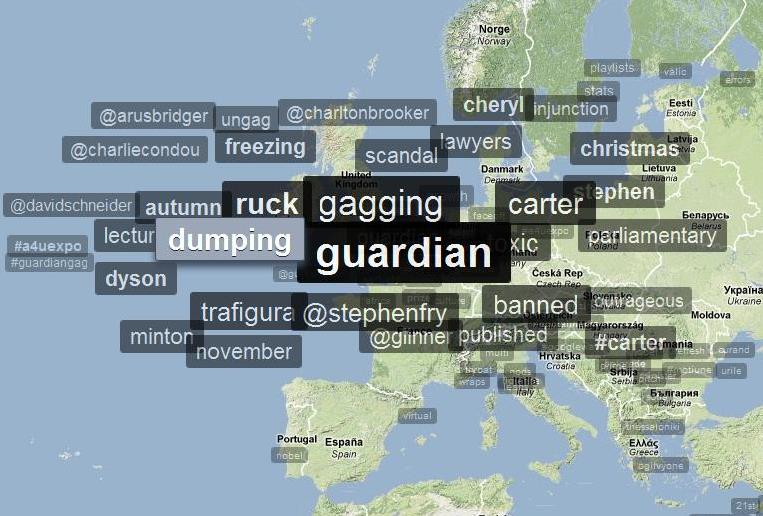
This is also another example of the Streisand effect in action. The fascinating TrendsMap shows that the words ‘Trafigura’, ‘Dumping’, ‘Gagging’ and ‘Guardian’ are the most talked about keywords. As @alexmassie says on Twitter:
Had never heard of Trafigura until they tried to ban the reporting of parliamentary proceedings. Fools.
1. As an aside – The House of Commons website is bloody awful. Anyone using the official record for any reason is likely going to want to cite a particular column, line, or question, rather than an entire webpage. The list of questions should be properly numbered so I can link direct to the part I want – in this case, question 61.
Balkanisation and the Internet
Via Robert Wright, here’s an interesting map of what Europe would look like, should all the current Independence movements in Europe get their way:

This illustrates the point Clay Shirky made about how Nation States might break down in the Internet Age, and my comments about how people might choose to constitute politcal units based on something other than brutal geography.
Votes and Violence in Iran
Its frustrating to maintain a blog, yet fail to comment on some of the most potent stories of the moment. Nothing doing here on the expenses row or the election of a new speaker.
Worse still, nothing on the ongoing protests and violence, following the recent disputed elections in Iran. That’s not to say I’m not engaged with what is happening. I’ve been following the pleas for help via the #iranelection tag on Twitter, and looking various photostreams on Flickr.
During the street protests that followed the Mumbai attacks, I said that social media has come of age
. But now, looking at the Iranian events, I worry about that. First, we have seen that the network is still vulnerable to interference from governments. And second, raising awareness of an event is not the same as establishing consensus, much less ensuring there is a critical mass of people for effective action.
I discussed this briefly in a post about the Burmese Monks protest (the short-lived “Saffron Revolution”) in September 2007. Despite the use of the Internet as a co-ordination tool, it seems that critical mass – or, to be more precise, the right kind of critical mass – is still an elusive Pot of Gold.

Update (13th July)
The image above, of protesters helping a battered policeman detatched from his riot-unit, was removed from Flickr a few days after being posted. It returned a few days later, with the faces of the protesters blurred. Apparently, the authorities have been using social networking sites to identify protesters and target them for arrest (or worse). That’s the dark side of new media.
Beyond Nations
In last month’s Prospect, David Goldblatt gave a couple of interesting statistics about Golf:
you have a global [golf] industry worth around $350bn. This is roughly the same as the GDP of Belgium, which coincidentally covers about the same land area as the world’s golf courses.
I was reminded of this just now, when I read a couple of statistics in the Shift Happens presentation by Karl Fisch.
- Nintendo invests double the US government in R&D (slides 31-32)
- If MySpace were a country, it would be the 11th Largest in the World (slide 35)
These are further examples of how companies and communities are now operating on a scale that dwarves the efforts of some nation states. As I said in my notes on the Clay Shirky’s ‘Hello Everybody’ Demos podcast that accompanies his book, I find it fascinating that the nation state might wither in the face of alternative communal bonds:
However, I wonder whether the most profound shift might come when people transcend ethnicity as well as geography. With people spending so much time, and actually making money in worlds like Second Life, or building large guilds of allegiences in Eve Online or WarCraft, perhaps those bonds could be the basis for some other kind of nation or ‘polity’ with real power and relevance.
To Be Continued, I’m sure.
Update: 24th Sept 09
If all the gaming consoles in the US formed their own city, that city would use as much power as San Diego, the 9th-largest city in the country. (via Kottke)