Pupil Barrister

Tag: Internet Philosophy (Page 32 of 39)

Robert is Blogging about Facebook

Clive Thompson in Wired, on How Twitter Creates a Social Sixth Sense:

Individually, most Twitter messages are stupefyingly trivial. But the true value of Twitter is cumulative. … When I see that my friend Misha is “waiting at Genius Bar to send my MacBook to the shop,” that’s not much information. But when I get such granular updates every day for a month, I know a lot more about her. And when my four closest friends and worldmates send me dozens of updates a week for five months, I begin to develop an almost telepathic awareness of the people most important to me.

Twitter is a kind of mini-blogging, where you can post message via text message. Thompson predicts that this feature will be incorporated into other applications… and indeed, a similar feature exists in Facebook, which incorporates a “status” field that you can fill in with whatever you wish.
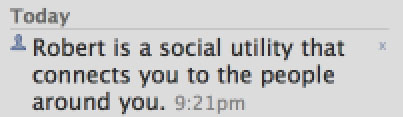
Facebook welcome screen
One feature of the Facebook feature is that the site automatically adds the word “is” to the start of the sentence (i.e. “Robert is…”). This can be frustrating when one’s status (whatever it may be) does not lend itself well to an “is”. I have to write “Robert is wanting…” instead of “Robert wants…”, and “Robert is thinking…” instead of “Robert thinks…”
Some people have been agitating to have this little quirk removed from the site. However, I think this would be a mistake. Sometimes, real creativity arises when one has to overcome constraints. Some of the best Facebook statuses (stati?) I’ve seen, have caused the obligatory “is” to be integral. When you realise that the first two words of a sentence are mandatory, a cliche suddenly seems inspired.
My recent favourites are both very much the epitome of 21st century urban life:

Gill is like, so, whatever.

and

Mike is just popping out to the shops, do you want anything?

Living With a Computer

Reading old articles, in which a journalist enthuses about a technology that is now obsolete, is always fun. Reading Jim Fallows, writing in 1982, describe what it is like Living With a Computer is no exception (via Daily Dish). There is plenty of discussion of how much memory to fork out for, and whether to buy a tape or floppy drive.

The system prints about thirty characters per second, which means it takes less than a minute per double-spaced page. When it has completed its work, I take the manuscript and start working it over with a pencil, just as I did in days of old. The difference is that after I’ve made my changes, I have only to type in the changes I have made and start the printer up again—rather than retype the whole mess.

This passage is echoed in an article by Umberto Eco, discussing how the process of drafting has changed with the advent of computers. Before, writers would compose one discrete draft after another until the thing was complete. Jim Fallows was following this same process in 1982. In these cases, the earlier drafts were actually on paper and might not be thrown away, leaving a resource for the author and researchers if required. Eco points out that these days, there are an indeterminate number of drafts and sub-drafts – “ghost drafts” he calls them – which are lost to the world.

It could be the case, though rare, that the author – narcissistic and fanatical about his own changes, and using some kind of special computer program – has kept somewhere, inside the memory of the machine, all these intermediate changes. But usually this does not happen. Those “ghost” copies have vanished; they are erased as soon as the work is finished.
And so the work of the philologists of the future will be based on conjecture, on what those “ghost” copies might have contained – and who knows how many great texts and other erudite publications will be born from that conjecture? To outsiders, they might seem like problems suited only for college exams. But the discussion shows that the use of mechanical systems for writing doesn’t necessarily simplify and thereby mechanise the creative activity, but rather can make it that much more shaded and complex.

Whenever I’m working on something creative, I do periodically make a copy of the document, especially when I’ve decided to purge a few paragraphs of verbosity. I don’t think this is particularly narcissistic, as Eco has it. It is just an insurance against changing your mind. Those thoughts that don’t make the cut might be useful for something else, later.

Update, 27th August

Matthew Kirschenbaum expands on this theme in The Chronicle Review.

What if we could use machine-learning algorithms to sift through vast textual archives and draw our attention to a portion of a manuscript manifesting an especially rich and unusual pattern of activity, the multiple layers of revision captured in different versions of the file creating a three-dimensional portrait of the writing process? What if these revisions could in turn be correlated with the content of a Web site that someone in the author’s MySpace network had blogged?

Remedy Scotland

One thing I have witnessed “first hand” is the anxiety – nay, terror – induced by the shocking MTAS system for appointing junior doctors. Various aspects of the mis-management continue to be discussed in the blogs and in newspapers, including the dumbing-down of the profession and the fact that some people are having to take on lower grade positions.
So, while I can concede that there are dozens of political groups that I could campaign for, I’ve lent my support to the junior doctors at Remedy Scotland by setting up a campaign blog for them. They have quite a focused campaign, with an achievable reform agenda, in a single policy area, so I am hoping that it can be quite incisive. Since so many people in Scotland will be affeced, a fairly disparate group of people will need to be mobilised. I am planning to utilise the full arsenal of Web 2.0 technologies to help spread the message. Expect blog buttons and such things very soon.
Do please visit the site and sign the petition. There is also a protest march planned for mid-July, in Glasgow.
remedy_scotland_logo

The New You

Another odd aspect of social networking sites, is the lack of control over how you actually do the networking.  As soon as anything to do with your real life is represented or linked to online, you surrender full control over that new identity. 
On Facebook, for example, you may have chosen a particular profile photograph which conveys a certain image.  It a version of yourself, which you choose to present.  And it is a version that is totally undermined when, say, your friends and family start tagging photographs of you dressed as a ballerina at a fancy-dress party.
Duncan O’Leary from Demos mused on the implications of this for job-seekers, late last year.  He pointed out that an employer can Google all the applicants for a job, unearthing all manner of embarrasment.  Think of the 19 year-old Scottish Parliamentary candidate, whose friends posted pictures of him drunk on various websites.  In such cases, the Internet is an annoyingly efficient conduit of information over which you have no control, but the cause and effect are both offline occurrences.   
But for an increasing number of people, the online community itself becomes part of who they are.  Participating on a forum, or writing a blog, is a leisure activity, Something That They Do.  With the coming of the Age of the Internet, we herald an era where we can create idealised versions of ourselves, identities that we can slip into, so we may relax and flourish (indeed, one correspondent of mine claims to have three or four different blog identities).  But it seems that this is only possible if one makes a clean break with reality, denying all contact with your offline self, your past.  Will the fact that I have an eponymous blog cause trouble for me one day? 
As soon as aspects your real life are represented online, that carefully crafted New You is undermined.  At the very least, deciding what parts of the Old You are represented online, should be a choice for the individual.  It should not be the choice of the individual’s girlfriend’s sister’s flatmate, who stole an impromptu snapshot in that bar, that one time.
The issue at stake here is, I think, starkly illustrated by the story of 13 year-old Casey Knibbs, who committed suicide after being bullied online.  If the Internet allows you to create and control the spaces you use for recreation and interaction, how on earth did bullies get in there?  Or rather, why was he not able to simply disable (or ‘Plonk’) their comments.  It is like being bullied by an imagninary friend. 
Fancy Dress Party

Faces in the virtual crowd

A couple of my mates use the social networking site Facebook to keep in touch. Like MySpace and others, you can create your own profile page, post messages and photos, and link your profile to other ‘friends’ (real, virtual, or merely imagined) on the network.
I think half the fun of these sites, is spending a little while following the forking paths of links, from a friend, to a friend’s friend, to a friend of a friend of a friend. Suddenly you find yourself browsing a page or two of photos, of a fancy dress party you did not attend, populated by people you don’t know. There’s a similarity to all these pictures – guys and girls lean in, drink in hand, for the pose. The snap shot is taken in haste: It is poorly composed; the automatic flash invariably over-lights the moment; and the subjects strike a ‘wacky’ pose, with tongues out and peace V-signs galore. I’ve taken dozens of pictures like this myself over the years. Its fun to wait a few extra seconds, to see how long the poseurs can maintain their, erm, posture.
One noteworthy aspect of these Facebook profiles is the choice the users make for their profile picture. Bizarrely, hundreds of people choose just such a party shot as their ‘face’, invariably one which includes other people as well. How are visitors supposed to know which face belongs to the profile they are reading, and which is that of some random punter who happened to fit their gurn into the shot as well?
I know there is a wealth of psychological extrapolations to be made from examining different people’s choice of avatar or profile picture. It is a chance to portray an aspect of yourself to the world. I notice a good proportion of bloggers keep their mug-shot off their site. Others, in common with those Facebook users, choose an impromptu snap, which suggests they wish to convey a modest yet carefree attitude – any old picture will do. But what does it say about a person when they add other people to their profile photo? Are they lacking a coherent identity of their own? Or merely showing us that they are so goddamned popular, that they cannot even find a picture of themselves that does not include some other fawning reveller.
I suppose the choice to portray yourself in a certain way is influenced by the tone of the site itself. In contrast to the naïf choices made by many Facebook users, the images displayed on the American site Spring Street Personals (which powers The Onion Personals) are all carefully chosen. Each is carefully cropped and displays a good looking young person who effortlessly exudes that counter-culture cool, which is central to the website’s brand. When similar images appear on Facebook, however, they seem arrogant and misplaced. And as with online virtual spaces, so it is in the real world. Design (whether graphic, interior, or fashion) frames the way we see ourselves, and how we interact with others.

« Older posts Newer posts »

© 2026 Robert Sharp

Theme by Anders NorenUp ↑