Pupil Barrister

Tag: Literature (Page 10 of 18)

Two e-Books

Last week, I published two e-Books for English PEN.
The first is Catechism: Poems for Pussy Riot, edited by Mark Burnhope, Sarah Crewe and Sophie Mayer. This is a fantastic piece of literary campaigning for three prisoners of conscience. The government of Vladimir Putin, in collaboration with the Russian Orthodox church, have sought to censor the satire and criticism directed at them by the punk art collective Pussy Riot, by convicting three of them on a charge of ‘hooliganism’.
There is little English PEN or I can do to help with the legal battle. But what we can do is ensure that the feminist poetry and the dissident message is not suppressed. Catechism amplifies what Putin sought to silence.
Download the eBook or buy a printed copy now! You can even make a donation if you feel so inclined.
The other project is PEN Atlas: 10 Literary Dispatches from Around the World. It has been published to coincide with the international translation day conference taking place today in London. It is a re-packaging off some of the best content from our PEN Atlas online project.

Download the e-book now!

In creating these publications, I applied some of the lessons learned during the course of my Insignificant Woman project. I also advanced my knowledge a bit too.
I had been using the EPUB conversion cool within Lulu.com to create my e-book files. This tool is simple and easy to use (you just upload a Word Document) but is somewhat limited. For example, when you want to place two headings adjacent to each other in the text, it creates unnecessary page breaks. However, by good fortune I happened across the Sigil tool on the Google Project Hosting repository. It is not an entry-level program, but it is perfect for someone like me, who has basic knowledge of HTML and CSS. I used it to tweak an existing EPUB file for Catechism, but then used Sigil to create the PEN Atlas file entirely from scratch. Later, I used Calibre to convert and EPUB file into a Kindle ready eBook.

Do Blogs Harm Literature?

“Books bloggers are harming literature” says Peter Stothard.  He is Chair of the Booker Prize, and editor of the Times Literary Supplement.  I am reminded of the comments of Helen Mirren and Andrew Marr, who have both previously complained about how the Internet is sending culture to the dogs.
From my vantage point, working on the edge of the literary sector, I don’t think Stothard’s analysis is true.  There is indeed a mass of blogged criticism online, just as there is a large amount of self-published literature.  However, authors and publishers of every size still seek reviews and approval from the prestigious literary journals like the London Review of Books and Stothard’s TLS.  An approving quote from a broadsheet critic will find its way onto the cover of the book; a similarly gushing endorsement from an individual blogger will not.  An essay in the established press will provoke a conversation and a public debate.  An piece of writing that is similarly erudite, but published on someone’s personal website will not have the same reach, nor puncture the public consciousness, in the same manner.  This is simply a question of reach and brand.
Of course, a few blogs transcend their medium and become credible sources for literary criticism:  Dovegreyreader springs to mind.  But this rise to credibility and influence is as a result of the quality of the literary criticism.  That is a good thing for literature – The poacher always turns gamekeeper, so-to-speak.  Contrast this to newspapers or some literary magazines, kept afloat as a loss-leader by rich patrons or media groups.  In such cases, their influence has effectively been bought, and their critics are more susceptible to the influence of the market and the quest for commerical readability.  It is this segment of the literary criticism ecosystem that should concern Mr Stothard.
In fact, in the niche of genre-literature, it is the bloggers who catalyse the art-form.  For example, the Pornokitsch website that puts out much more quality literary criticism than the Guardian, which can only muster a single monthly round-up of the latest sci-fi.  Who is doing more for that kind of literature?
Perhaps Stothard is actually conflating bloggers with the reviewers on Amazon and elsewhere, who often write batshit crazy reviews, giving five stars or one star, without having read the book.  This is indeed a problem, as it ruins the Amazon product review system.  However, I doubt that the few people who find such comments credible have much in common with those who read the TLS or the LRB.  More to the point, I can’t believe that the product reviews on e-commerce sites have provoked a single authors into changing the way they write, or what they choose to write about.
 

'Crossroads' Published! Buy Now for the Kindle


I am delighted to announce that Crossroads has today been published, and is available to purchase for the Kindle in the Amazon store.
Crossroads, you will recall, is a short anthology of new short stories, including a contribution from myself, entitled ‘(0,0)’. The plot involves a chance encounter, a missed opportunity, and some maths.
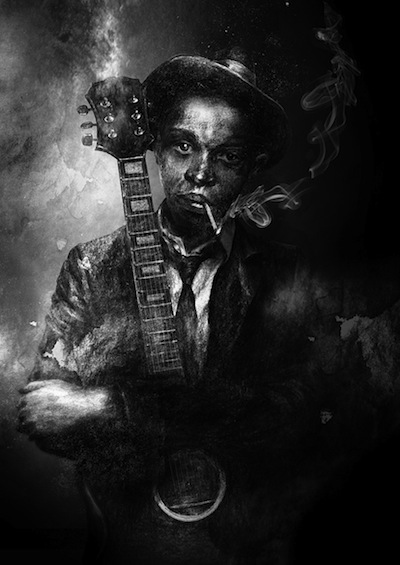
The other stories are ‘Prignitz Was An Innocent’ by Christian Fox, a dark, dark retelling of the Pied Piper færy tale; ‘Georgia’ by Jenni Hill, about a demon having a frustrating time at work (which made me smile); and ‘The Golds’ by Ian Whates, a tight fable about music and sacrifice. The noir cover illustration of Robert Johnson is by Vincent Sammy. ‘Tis an impressive group and I’m proud to make my literary debut on those (electronic) pages.
The publishers are Jurassic London, who are making a habit of publishing fantastic collections of genre fiction. Their recent Stories of the Smoke collection was timed to co-incide with the Dickens bicentenary and included a royalty donation to English PEN (which is how I came to meet them). Crossroads is actually a companion volume to the limited edition Lost Souls, a collection of ‘lost’ stories from writers such as Arthur Conan Doyle, Benjamin Disraeli, John Galsworthy and Amelia Edwards.
Buy Buy Buy! And/or: Come to the launch event tonight.

Crossroads cover

Crossroads (cover) by Vincent Sammy

Günter Grass and the Free Speech Moment

Last week I wrote a follow up to my Comment Is Free piece on Gunter Grass, this time for the New Statesman blog.
Over the past few days, a “free speech moment” has been unfolding. These are the controversies where we get to discuss the first principles of free expression, and they usually begin when someone does something extremely offensive. Think of the public trolling of Anjem Choudry, or the English Defence League. Think of Liam Stacey, charged with a criminal offence for tweeting. Think of every controversial columnist, paid by the newspapers to be politically incorrect. These moments are frustrating, but at least campaigners like me are asked to make the case for free expression afresh, on sites such as this one.
This week, the “free speech moment” has had both an historical and international flavour. Günter Grass, the Nobel Prize Winning German author, angered the Israeli government after he wrote a poem about their militarism. Israel, incensed that a former conscript in the Waffen-SS should write such a criticism, responded by placing a travel ban on the author. In the most recent twist, Grass has escalated the controversy by likening the Israeli government’s actions to those of the East German Stasi.
There are two unresolved issues here. The first is whether a travel ban (declaring Grass a persona non grata, unwelcome should he wish to visit Israel again) is censorship. Clearly, such a move is less severe than the formal banning of Grass’s books; and many authors around the world (for example, in Iran, which was cited in the poem) suffer imprisonment for their transgressions. Nevertheless, placing this restriction on a person, purely because of what they have written, is a form of censorship.
It prevents any Israeli citizens who happen to agree with Grass’s poem (and I am sure there are many, from every religion) from inviting him to speak. It precludes the possibility that those in Israel who enjoy Günter Grass’s oeuvre would ever have the chance to meet him at a literary event. A voice is suppressed. Until recently, the UK Border Agency were in the habit of denying authors and artists entry to the UK because a gallery opening or a book tour was considered a form of “work”. English PEN campaigned for reform of the system on the basis that freedom of expression also includes freedom of information, the right to hear dissenting voices. A travel restriction on an author denies this freedom, which makes it undemocratic.
Such bans also have a “chilling effect” on other writers – will authors who regularly visit Israel now self-censor, if they hold opinions that the Israeli government doesn’t want to hear?
The second issue is over Günter Grass’s actual words, including his latest ‘Stasi’ interjection? These “free speech moments” are frustrating because defending someone’s right to say something is usually equated with defending the content of what they say. Those whom the speaker has offended are always ready to conflate the two issues. We should remember that the oft-cited Tallenter quip on free speech (“I hate what you say, but defend to the death your right to say it”) also works perfectly well in reverse: I defend Günter Grass’s right to say things . . . but I hate what he says. The writer Kenan Malik goes further, and makes the point that if one vigorously defends free expression, one also has a moral duty to retort when people say unpleasant things.
I don’t think that Günter Grass is saying abhorrent things, though in my opinion he has been deeply insensitive. His last comment is clearly a doubling-down, and the result is polarising. His poem, despite taking on the form of introspection, has not persuaded anyone that was not already of his point-of-view. For such an accomplished writer, celebrated for his turn of phrase, this is a shame. The great power of poetry and prose is their ability to help the reader empathise with someone of a different culture or history. Personally, I think Grass is capable of this, and should have written a different poem. But to say this is an act of literary criticism, not a statement of the principles of free speech.
The Great Banner Wall of China

This week English PEN has been at the London Book Fair. China was the ‘Market Focus’ country and as such, there were a lot of Chinese state-run stands at the fair.
I joined with activists from the Tibet Society and the Independent Chinese PEN Centre to stage a poetry protest in front of the Chinese Government stands. The poetry we recited earned their authors a ten year prison sentence.
Later, GAPP officials used a load of pull-up conference banner stands to block the protest from view. “The Great Pull-Up Banner Wall of China”. Not a good look, in a trade fair designed to promote openness.
I was also reprimanded by the security guards for holding up a sign saying ‘Free Speech is not a crime’ on carpet owned (or at least, paid for) by the Chinese government.

« Older posts Newer posts »

© 2026 Robert Sharp

Theme by Anders NorenUp ↑